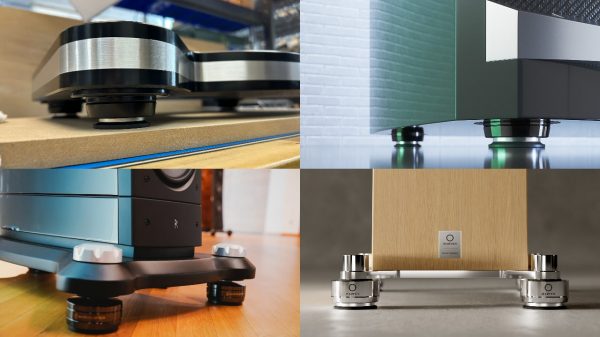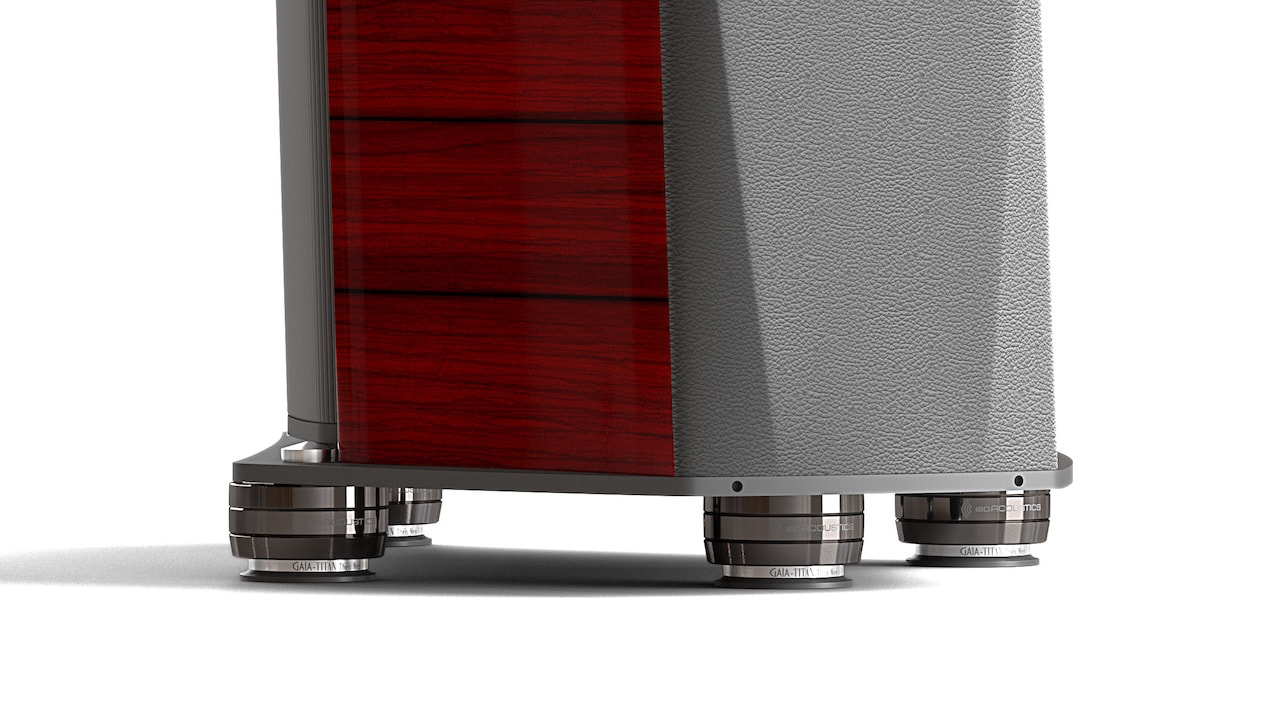
Audiophiles will spend extraordinary amounts of money on loudspeakers, amplifiers, cables, and equipment racks, but the connection between their speakers and the floor is often treated as an afterthought. For decades, spikes were the default solution, even when they were digging holes into hardwood flooring or doing little to prevent unwanted vibration from traveling between the loudspeaker and its supporting surface.
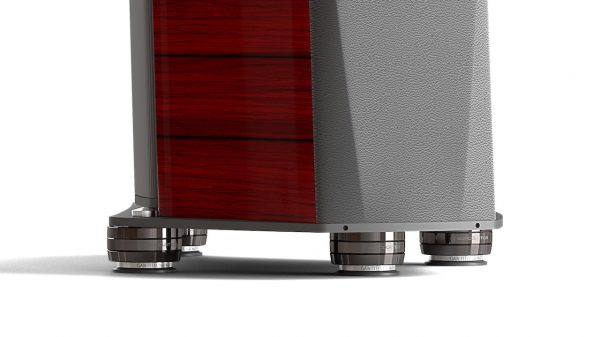
Canadian manufacturer IsoAcoustics has spent years challenging that approach with engineered isolation products designed to address a genuine mechanical problem. Its new GAIA-TITAN Neo series takes that concept to another level, supporting extremely heavy floorstanding loudspeakers and subwoofers weighing up to 620 lbs (280 kg).
The real news is that technology already incorporated into flagship loudspeakers from JBL and Marten is finally available to consumers as an aftermarket upgrade. With three models priced between $1,264.99 and $1,954.99 per set of four, this isn’t an inexpensive accessory, but IsoAcoustics isn’t targeting owners of $500 bookshelf speakers either.
From Flagship Loudspeakers to Your Listening Room
We first covered the new GAIA Neo series in May 2025, when IsoAcoustics previewed its next generation of loudspeaker isolation technology. The company subsequently expanded its OEM partnerships with JBL, Marten, and Innuos, moving its technology beyond aftermarket accessories and into the engineering of high-end audio components.
Marten incorporated GAIA-TITAN Neo-derived isolation into its extraordinary €950,000 Coltrane Supreme Extreme loudspeakers, while JBL followed with custom, semi-recessed versions for its Summit Everest and K2 flagships at HIGH END Vienna 2026.
These are manufacturer-specific implementations rather than identical retail feet, but they share the same underlying isolation technology.
The distinction is significant. Instead of designing a loudspeaker and leaving isolation to the owner, these manufacturers made it part of the original engineering. With the retail GAIA-TITAN Neo series, IsoAcoustics is extending that approach to owners of existing high-mass loudspeakers and subwoofers.
What’s Actually Different About GAIA-TITAN Neo?
The original GAIA-TITAN series already supported loudspeakers weighing up to 620 pounds, so the new models do not introduce higher weight capacities. The important changes involve the internal isolation elements and their mechanical integration.
IsoAcoustics has refined the geometry, thickness, materials, and durometer of the internal isolators to improve vibration management under substantial loads. Unlike conventional spikes, which create a relatively rigid mechanical connection to the floor, the GAIA-TITAN Neo is designed to reduce energy transfer between the loudspeaker and the supporting surface.
Here’s what IsoAcoustics says has been changed:
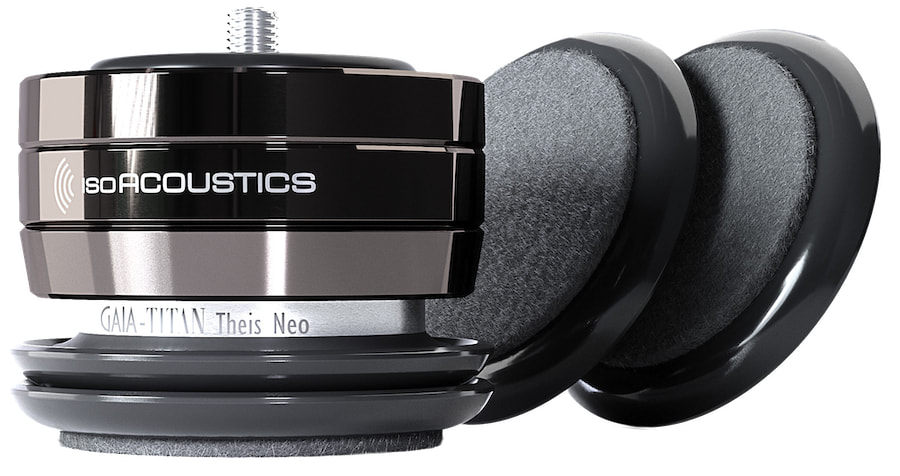
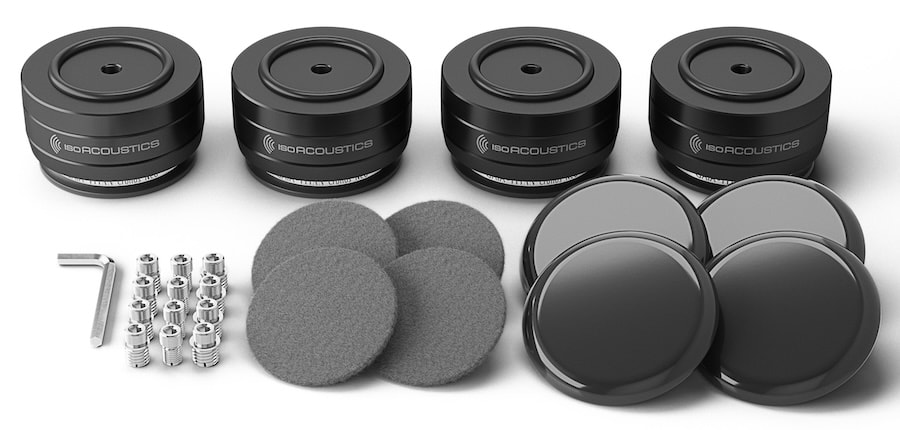
- Integrated height adjustment: Each isolator provides up to 0.34 inches (8.5 mm) of adjustment through a rotating lower ring, allowing users to level heavy loudspeakers without disturbing the isolator’s alignment.
- Simplified installation: An integrated O-ring compresses as the isolator is tightened, creating a secure connection while allowing it to be rotated into position.
- Flush-fit housing: The visible lock nut used on the original GAIA-TITAN has been eliminated, creating a cleaner appearance beneath the loudspeaker.
- Articulating lower isolator: The contact surface can pivot to accommodate slightly uneven floors.
- Included floor sliders: These make positioning heavy loudspeakers easier and should be removed once installation is complete for optimal isolation.
For anyone who has attempted to level a 200-pound loudspeaker on an uneven hardwood floor, those improvements are more than cosmetic. Moving something that weighs as much as a refrigerator without damaging the floor or your back is a worthwhile objective.
IsoAcoustics GAIA-TITAN Neo Specifications
Three models are available, with the maximum supported weight applying to a complete set of four isolators, not an individual foot.
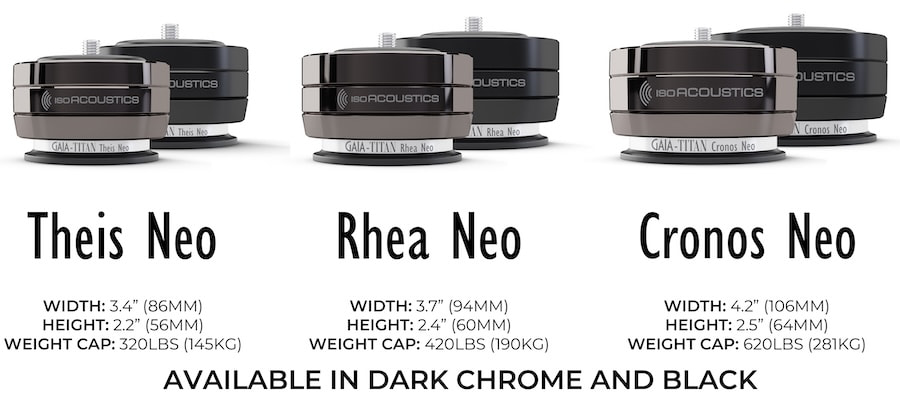
Theis Neo Rhea Neo Cronos Neo Maximum supported weight 320 lbs (145 kg) 420 lbs (190 kg) 620 lbs (280 kg) Width 3.4 in (86 mm) 3.7 in (94 mm) 4.2 in (106 mm) Height 2.2 in (56 mm) 2.4 in (60 mm) 2.5 in (64 mm) Height adjustment 0.34 in (8.5 mm) 0.34 in (8.5 mm) 0.34 in (8.5 mm) Included thread sizes 1/2″-13, M8-1.25, M14-2.0 1/2″-13, M8-1.25, M14-2.0 1/2″-13, M10-1.5, M14-2.0 US price (set of four) $1,264.99 $1,494.99 $1,954.99
All three models are offered in black or dark chrome, with alternative thread adapters available through IsoAcoustics distributors.
Owners need to confirm that their loudspeakers have compatible threaded mounting points. The new GAIA Neo adapters are not interchangeable with those used by the original GAIA series, and choosing the correct model requires matching its capacity to the loudspeaker’s total weight.
IsoAcoustics offers an online product selector to help with compatibility, along with optional GAIA Carpet Disks for thick-pile carpeting and the GAIA F1 Speaker Jack for lifting heavy loudspeakers during installation.
Does Loudspeaker Isolation Really Improve Sound Quality?
We’ve spent years evaluating IsoAcoustics products, including the ISO-PUCK mini, Aperta stands, isolation platforms, and original GAIA series. Our experience has generally been positive, although the results depend on the loudspeaker, supporting surface, and installation.
In my review of the GAIA III isolation feet, using Q Acoustics M40, 5040, and 3050i loudspeakers, the improvements in bass definition, imaging, and soundstage dimensions were clearly audible. The presentation became more spacious without fundamentally changing the loudspeakers’ tonal balance.
Our earlier ISO-PUCK mini review demonstrated similar benefits with affordable bookshelf loudspeakers positioned on shelves and media units, although we also noticed subtle changes in perceived midrange warmth with some combinations.
Those results provide a useful foundation for assessing the new GAIA-TITAN Neo, but they do not establish its performance relative to the original GAIA-TITAN. We have not tested the new heavyweight models.
Isolation also has limitations. It cannot eliminate room modes, correct poor loudspeaker placement, or compensate for fundamental design shortcomings. Anyone promising otherwise probably has a rather expensive power cable to sell you as well.
The Bottom Line
The GAIA-TITAN Neo brings credible isolation engineering and meaningful installation improvements to owners of extremely heavy loudspeakers and subwoofers. Our experience with IsoAcoustics products gives us reason to take the technology seriously, but the new models still need to prove their advantage over the originals. At these prices, they’re best suited to owners of reference-level systems who have already addressed room acoustics and speaker placement. The potential is compelling, but the investment deserves an actual listening test.
Pricing & Availability
The IsoAcoustics GAIA-TITAN Neo series is available worldwide beginning November 6, 2026, through the company’s authorized dealer and distributor network.
- GAIA-TITAN Theis Neo:
- $1,264.99 (US), $1,499.99 (CA), €1,299.00(EU), £1099.00(UK)
- GAIA-TITAN Rhea Neo:
- $1,494.99 (US), $1,799.99 (CA), €1,599.00(EU), £1299.00(UK)
- GAIA-TITAN Cronos Neo:
- $1,954.99 (US), $2,349.99 (CA),€1,999.00(EU), £1699.00(UK)
For more information: isoacoustics.com
Related Reading: