
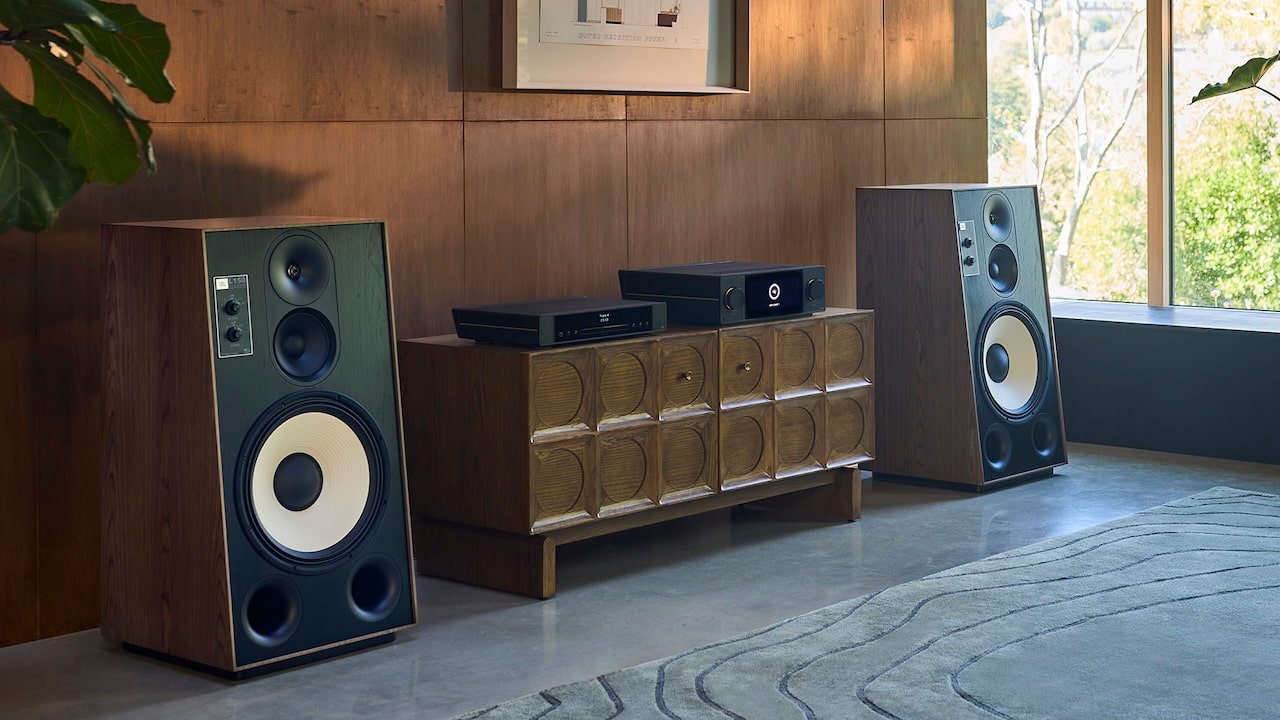
JBL has never been particularly interested in making loudspeakers that disappear into the furniture, and its new L150 Classic isn’t about to change that. The $9,999 per pair floorstanding loudspeaker becomes the flagship of JBL’s Classic Series, bringing a massive 15-inch woofer, three-way acoustic design, and unmistakable 1970s styling to listeners who believe loudspeakers should look as substantial as they sound.
Unveiled by HARMAN Luxury Audio Group, the L150 Classic builds on the heritage established by the L100 Classic MKII, but takes the concept in a bigger direction. With modern driver technology, redesigned crossovers, and adjustable acoustic controls, JBL is targeting audiophiles who want the scale and dynamic impact of its vintage loudspeakers without the limitations of a fifty-year-old design.
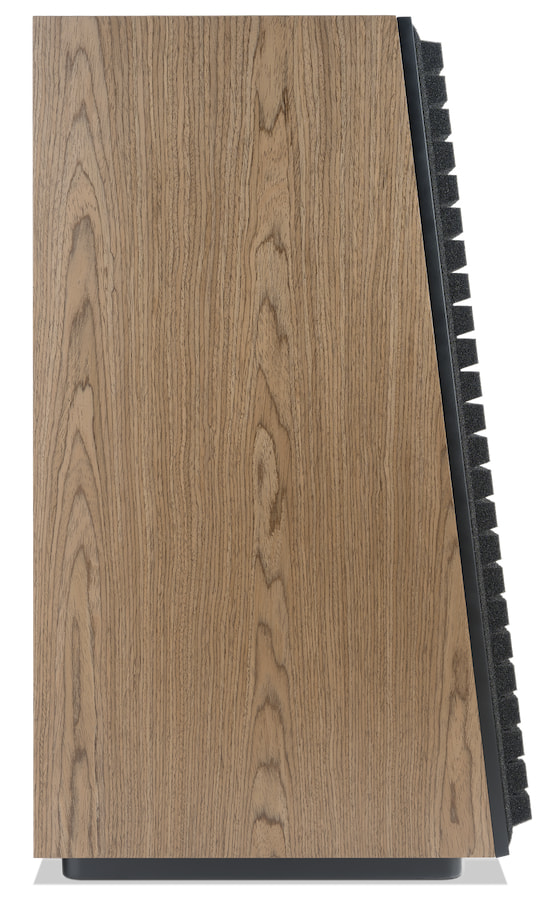
And yes, it has the famous Quadrex foam grille. Because nothing says 1970s hi-fi quite like a walnut cabinet that looks ready to play Physical Graffiti at a volume the neighbors will remember. And don’t be ashamed to invite the police inside when that happens.
Related Reading:
- JBL Debuts Summit Everest And K2 Flagship Loudspeakers At High End Vienna 2026
- JBL Marks 80 Years Of Audio History With L100 Classic 80 Anniversary Edition Loudspeaker
JBL’s Classic Series Finally Gets a Proper Floorstander
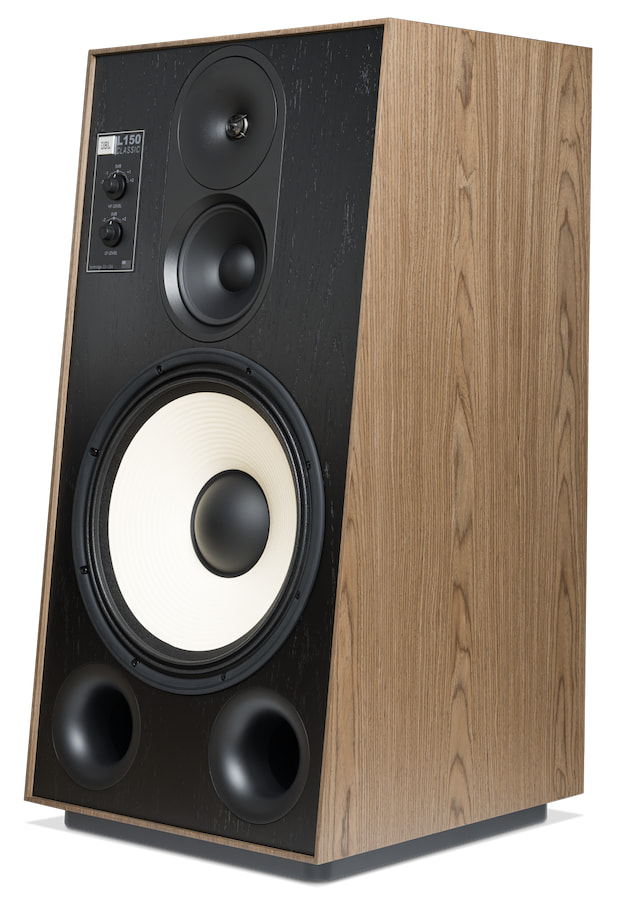
Although JBL has spent years revisiting its most recognizable home loudspeakers, the L150 Classic represents an important expansion of the current Classic Series. It’s the first floorstanding model in the family and the first to incorporate a 15-inch woofer, positioning it above the L100 Classic MKII, L82 Classic MKII, and smaller L52 Classic.
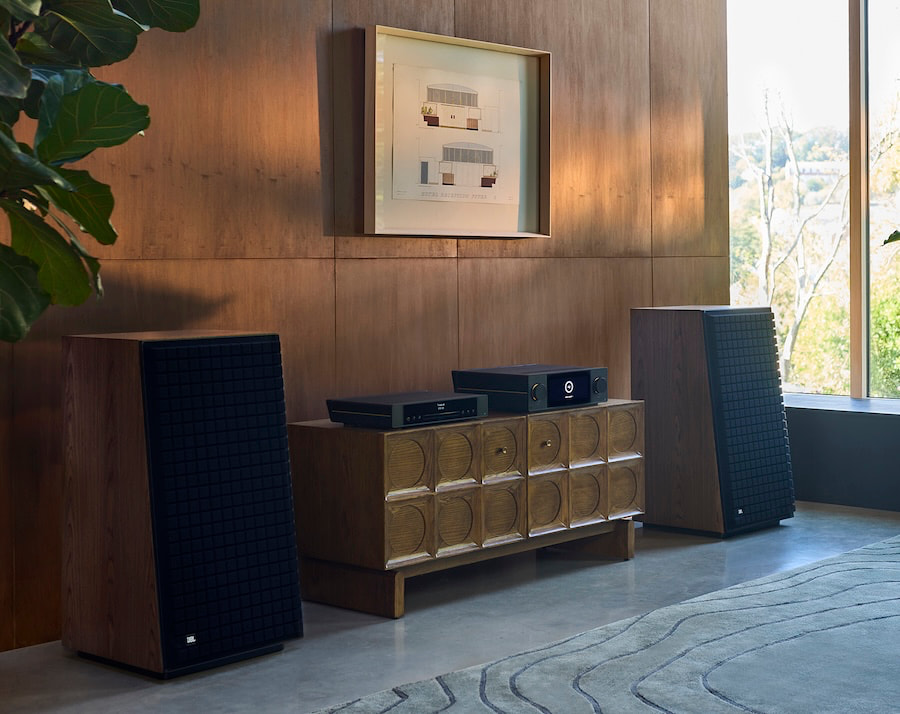
The design draws inspiration from JBL’s large-format loudspeakers of the 1970s rather than reproducing an existing model component for component. Its broad cabinet, natural walnut veneer, black front baffle, and magnetically attached Quadrex grille maintain the visual connection to the past, while the internal engineering reflects contemporary loudspeaker development.
There’s also an important distinction in JBL’s hierarchy. The L150 Classic is the flagship of the Classic Series, not JBL’s overall flagship loudspeaker. That distinction belongs higher up in the company’s substantially more expensive Summit Series, where models such as the Everest and K2 occupy an entirely different category.
At under 37 inches tall, the L150 isn’t especially imposing in height, but its wide cabinet and substantial depth demand considerably more floor space than a conventional slim tower. Each enclosure weighs more than 114 pounds, which should make the question of where to place them a discussion worth having before the delivery truck arrives.
Modern JBL Engineering Beneath the Retro Exterior
The heart of the L150 Classic is its large Pure Pulp Differential Drive woofer, which uses JBL’s proprietary motor technology to improve control, thermal performance, and power handling. Differential Drive employs a dual-voice-coil, dual-magnetic-gap approach intended to reduce power compression and distortion at higher playback levels, drawing on engineering JBL has employed in its professional and premium loudspeaker systems.
The dedicated polymer-coated Pure Pulp midrange driver handles vocals and instruments, while a titanium dome tweeter works with an acoustic lens and waveguide to control high-frequency dispersion. Unlike the compression-driver and horn arrangements found in some of JBL’s larger premium models, the L150 uses a conventional dome tweeter architecture optimized for its three-way system.
The result, according to JBL, is a loudspeaker designed to reproduce large dynamic swings without losing the clarity and spatial precision expected from a contemporary high-end system. That’s a reasonable engineering objective, but claims about effortless dynamics and superior imaging will need to be evaluated through independent listening and measurements.
Room Adjustments Without Another App
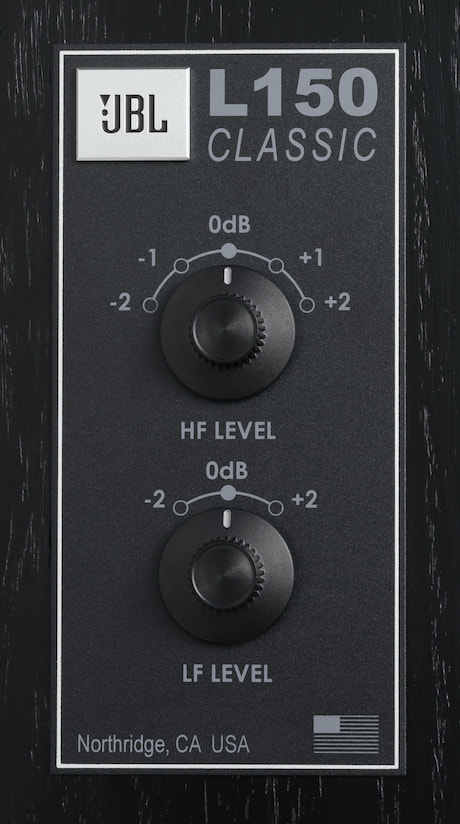
One of the L150 Classic’s more useful features is its pair of front-panel high- and low-frequency level controls, which allow owners to adjust the tonal balance without relying on external equalization. That flexibility can be particularly valuable in real listening rooms, where wall proximity, furnishings, and personal preferences often matter as much as theoretical laboratory performance.
The bass-reflex enclosure uses two front-firing ports, while an angled cabinet profile and sloped baffle help direct sound toward the listening position. The front-facing ports offer some placement flexibility, although they don’t eliminate the need to experiment with speaker positioning and room boundaries.
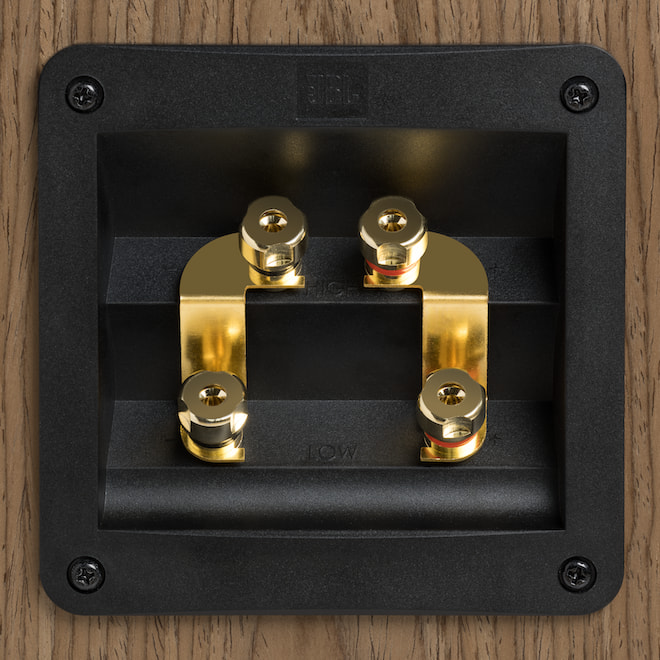
JBL also provides separate crossover sections and dual gold-plated binding posts for bi-wiring or bi-amplification. Neither is essential for achieving good performance, but they give owners more flexibility when building or upgrading a dedicated two-channel system.
Don’t Assume That Big Woofer Means Easy to Drive
One specification worth examining is the L150 Classic’s combination of moderate sensitivity and relatively low nominal impedance. Despite its substantial driver complement, this isn’t a high-efficiency design intended to deliver enormous output from a handful of tube watts.
A properly matched amplifier with stable performance into a 4-ohm load will be important, especially for listeners hoping to reproduce demanding orchestral recordings, live rock performances, or electronic music at realistic levels. JBL’s suggested amplifier range is broad, but the practical choice should reflect room size, listening distance, and desired playback levels rather than simply the largest wattage figure on the box.
JBL L150 Classic Specifications
- Speaker type: 3-way passive floorstanding loudspeaker
- Woofer: 15-inch (380mm) Pure Pulp Differential Drive with cast frame
- Midrange: 6.5-inch (165mm) polymer-coated Pure Pulp driver with cast frame
- Tweeter: 28mm titanium dome with waveguide and acoustic lens
- Enclosure: Vented bass-reflex with dual front-firing ports
- Frequency response: 33Hz – 22.5kHz with LF control at 0dB; 30.5Hz – 22.5kHz with LF control at +2dB
- Sensitivity: 88dB (2.83V/1m)
- Nominal impedance: 4 ohms
- Recommended amplifier power: 25-250 watts RMS
- Crossover frequencies: 310Hz and 1.8kHz
- Acoustic adjustments: Front-panel high- and low-frequency attenuators
- Connections: Dual gold-plated binding posts supporting bi-wiring and bi-amplification
- Cabinet finish: Natural walnut veneer with black Quadrex foam grille
- Grille: Magnetically attached and removable
- Dimensions (HxWxD): 36.8 x 18.5 x 21.2 inches (935 x 470 x 540mm)
- Weight: 114.6 lbs (52 kg) per speaker
- Included accessories: Quadrex grille and four spike feet per speaker
How Does the JBL L150 Classic Compare With the Competition?
At nearly $10,000 per pair, JBL is entering a competitive segment where several established manufacturers offer large-format loudspeakers with equally strong heritage credentials. Two particularly relevant alternatives come from Klipsch and Fyne Audio, although they take different approaches to driver technology and acoustic design.
Klipsch Cornwall IV ($7,299 per pair) is an obvious American competitor, combining a 15-inch woofer with horn-loaded midrange and high-frequency drivers. The Cornwall IV has substantially higher rated sensitivity and is considerably easier to pair with lower-powered amplification, making it attractive to tube amplifier enthusiasts. Its presentation and dispersion characteristics will differ from JBL’s dome-tweeter design, and the price difference leaves room in the budget for other system improvements.
Fyne Audio Vintage Classic X ($8,999 per pair) offers another interpretation of traditional large-cabinet loudspeaker design, using a 10-inch IsoFlare point-source driver, titanium compression tweeter, and downward-firing BassTrax port system. Its coaxial architecture and higher rated sensitivity distinguish it from the JBL, while the retro cabinet styling and adjustable acoustic features target a similar audience. The Fyne is also closer in price, making it an especially relevant option for listeners considering premium heritage-inspired loudspeakers.
Both alternatives demonstrate that vintage styling alone isn’t enough to justify a premium price. The real differences will come down to dispersion, tonal balance, bass performance, amplifier compatibility, and how each loudspeaker interacts with the listening room.
The Bottom Line
The JBL L150 Classic makes the strongest case for itself among listeners who want a serious two-channel loudspeaker with the physical presence and dynamic ambitions of vintage American hi-fi. Its appeal extends beyond nostalgia, with modern driver engineering, adjustable tonal balance, and a large-format enclosure that prioritizes acoustic capability over the slim cabinet proportions favored by much of today’s market.
The limitations are equally clear. These are substantial loudspeakers that demand floor space, capable amplification, and a willingness to spend nearly $10,000 before accounting for the electronics needed to drive them properly.
What interests me most is JBL’s decision to preserve the Classic Series identity rather than turn the L150 into a smaller version of its Summit loudspeakers. There’s still an audience for large woofers, walnut cabinets, and physical controls that don’t require a firmware update.
The L150 Classic looks like the kind of loudspeaker JBL should be building. Whether it sounds like a $10,000 improvement over the competition is something we’ll have to determine when a review pair becomes available in 2027.
Pricing & Availability
The JBL L150 Classic is priced at $9,999 per pair, with availability expected in 2027 through authorized JBL retailers. It made its public debut at Audio Video Show 2026 in Warsaw, Poland, from October 23-25, giving attendees an opportunity to hear the new design before its commercial release.
According to HARMAN Luxury Audio Group, production is scheduled to begin in December 2026, with regional inventory expected before the end of the first quarter of 2027.
For more information: JBL’s official product page.
Related Reading:








ORT
October 27, 2026 at 5:04 pm
Well, stick a candle up my nose and call me Jack ORT Lantern! I don’t love myself enough to spend this much (all at once) on me but if I did?
I would.
And wouldn’t the sound (and looks!) be loverly?!
ORTson Welles
Ian White
October 27, 2026 at 5:52 pm
ORT,
They’re kinda sexy. I dig the large woofer.
IW